
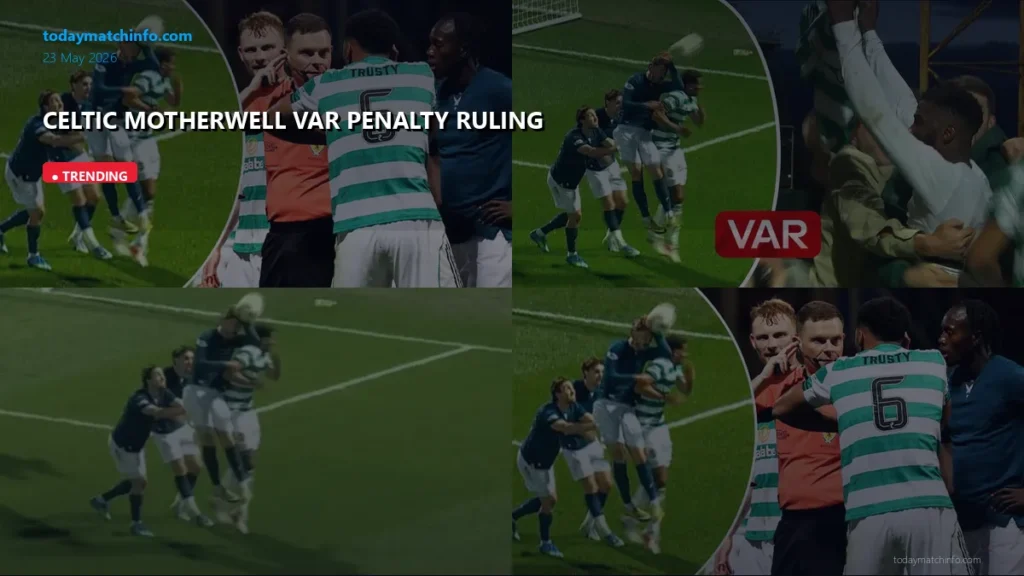
The 2025/26 Scottish Premiership season will be remembered for its dramatic conclusion, but the legacy of the title race is now inextricably linked to a single, controversial refereeing decision. After weeks of intense debate, the Scottish Football Association’s (SFA) Key Match Incident (KMI) panel has officially ruled that Celtic should not have been awarded a late penalty in their 3-2 victory over Motherwell earlier this month.
The decision, which occurred in the 99th minute at Fir Park, proved to be a pivotal moment in the battle for the league trophy. With the match tied at 2-2, referee John Beaton was instructed by the VAR official, Andrew Dallas, to review a potential handball by Motherwell’s Sam Nicholson. Despite Beaton initially waving play on, a brief pitchside review led to a penalty award, which Kelechi Iheanacho coolly converted to secure a vital win for the Hoops.
The Verdict: A “Wrong” Intervention
The KMI panel’s findings, released this week, have provided a cold dose of reality for those seeking clarity. In a 2-1 vote, the panel concluded that Beaton’s original decision to allow play to continue was correct and that VAR should not have intervened to prompt an on-field review.
The ruling has sparked significant discourse regarding the threshold for VAR intervention in Scotland. One panel member dissented, maintaining that a penalty was correct, but the majority agreed that the incident did not constitute the “clear and obvious error” required to overturn the referee’s initial call.
“Two panel members felt VAR was incorrect to intervene and the penalty was incorrectly awarded for handball after OFR (on-field review),” the report stated.
The incident has since been categorised with a high difficulty rating, highlighting the ongoing challenges officials face when balancing technology with the subjective nature of handball rules.
The Domino Effect on the Title Race
The repercussions of that spot-kick extended far beyond the touchline at Fir Park. Had the match finished in a draw, the final day of the season—the title decider between Celtic and Hearts—would have carried significantly different stakes. As it stood, Celtic’s win ensured they entered the final showdown at Celtic Park with a one-point lead, whereas a draw would have necessitated a scenario where Hearts only needed to avoid a heavy defeat to be crowned champions for the first time since 1960.
Hearts manager Derek McInnes had been vocal in his frustrations, branding the decision “disgusting” and highlighting that his side had been denied a similar penalty claim earlier in their own fixture against Motherwell. The controversy deepened the scrutiny on match officials, with reports suggesting referee John Beaton required police protection after his personal details were circulated online in the wake of the match.
Why It Matters to UK Football
The fallout from this incident has become a focal point for the wider conversation about the integrity of the Scottish game. With the Scottish Professional Football League (SPFL) now investigating several matches from the season’s conclusion—including incidents of pitch invasions and unacceptable conduct—the focus is shifting toward how the authorities can restore faith in the officiating process. For fans, the incident serves as a stark reminder of how technological intervention, while designed to improve accuracy, can sometimes amplify the very frustrations it seeks to resolve.
FAQ
Why was the Celtic penalty against Motherwell considered controversial?
The penalty was awarded in the 99th minute for a suspected handball by Sam Nicholson. Many fans and pundits, including those on the SFA’s KMI panel, felt the contact was incidental and that the referee’s initial decision to play on should not have been overturned by VAR.
What is the SFA KMI panel?
The Key Match Incident (KMI) panel is an independent body that reviews significant refereeing decisions in the Scottish Premiership. While their rulings do not change the result of matches, they provide transparency and assessment of whether officials and VAR adhered to the correct protocols.
How did this decision impact Hearts’ title hopes?
The penalty secured a win for Celtic, keeping them ahead of Hearts in the table. This forced Hearts to win the final-day decider at Celtic Park to claim the title, rather than being able to rely on a draw or a narrow loss, ultimately contributing to their heartbreak as Celtic clinched the trophy with a 3-1 victory.
—
As the dust settles on another high-octane season, the conversation surrounding VAR in Scotland is unlikely to quieten. While Celtic fans celebrate a hard-fought league title, the debate over the Motherwell incident serves as a cautionary tale about the fine margins that define modern football and the heavy burden of responsibility placed on those with the whistle.