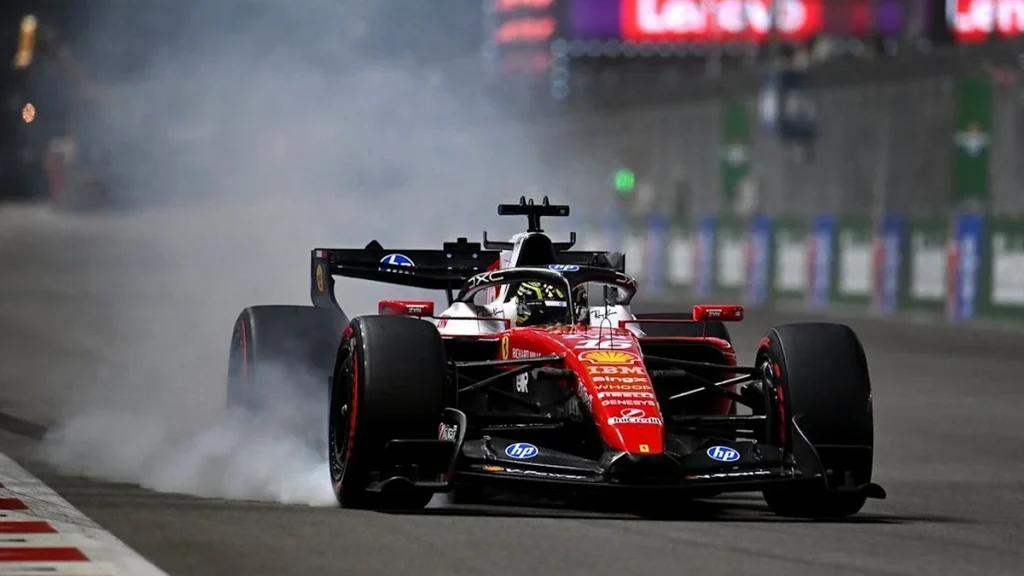

Max Verstappen has offered a technical insight into Ferrari’s persistent lack of top speed, citing the team’s deliberate choice to run a smaller turbocharger. Although the Dutch driver secured the second-fastest time in qualifying for the Formula 1 Las Vegas Grand Prix, he noted that his RB22 suffered from a mysterious issue that prevented a faster lap. However, Verstappen’s observation highlights a broader strategic trade-off for the Scuderia, where the smaller turbo provided a significant advantage off the line early in the season but has since become a liability on long straights.
Key Match Highlights & Tactical Analysis
The impact of this design choice was starkly evident during the Las Vegas session, marking the first time since Imola 2025 that both Ferrari cars were eliminated in Q2. Lewis Hamilton attributed his exit to a combination of floor damage and deployment issues, estimating that the missing floor section cost him three to four tenths of a second, while the deployment problem shaved off another six tenths. These mechanical setbacks compounded the inherent aerodynamic and power unit limitations, leaving the SF-26 unable to match the outright pace of its rivals on the high-speed layout.
Further analysis confirms that Ferrari’s performance gap is not merely anecdotal but backed by official FIA measurements. The Italian manufacturer has received two ADUO tokens, indicating that their internal efficiency is between 2% and 4% lower than the best in the field. This data validates Verstappen’s theory that the pursuit of launch performance has come at the cost of top-end speed, a challenge Ferrari must address as the 2026 regulation era approaches and the balance of power shifts.
Source: Yahoo Sports