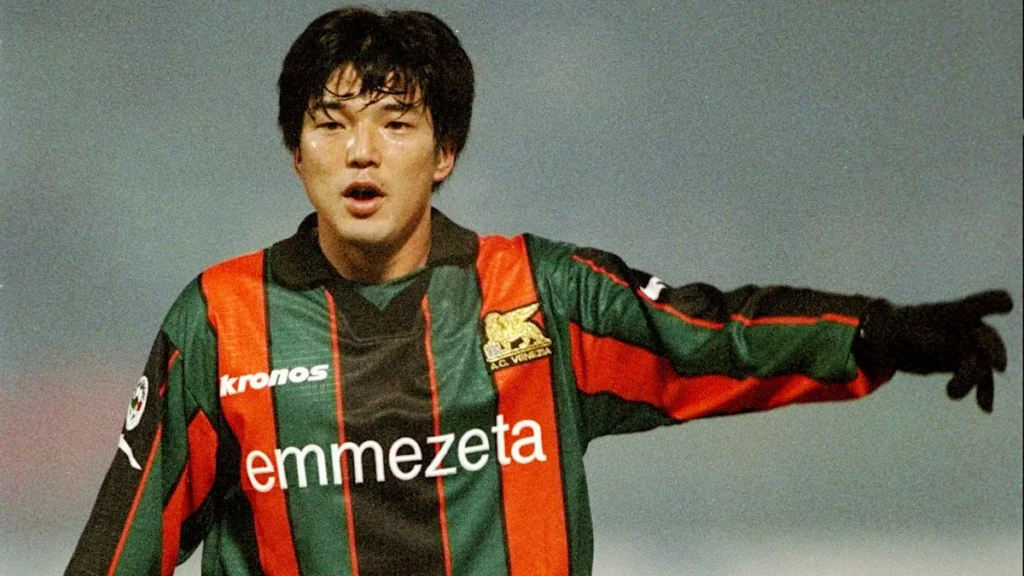

Hiroshi Nanami emerged as the serene antithesis to the rising obsession with physical power in modern football, utilizing his sublime left foot as a tactical compass rather than a mere weapon. As the undisputed metronome for Júbilo Iwata and the iconic number 10 for the Samurai Blue, Nanami did not rely on aimless running to influence the game; instead, he controlled the tempo with such precision that he could effectively roll the entire pitch in the palm of his hand. His ability to dictate the rhythm of play allowed him to elevate the intelligence of his teammates, establishing a legendary reputation as a master tactician who proved that football’s ultimate truth lies in controlling the flow of the match.
How the J.League maestro redefined playmaking intelligence in football’s golden era.
Nanami’s career trajectory traced a path from the quiet fields of Fujieda in Shizuoka to the historic canals of Venice, culminating on the grand stage of the 1998 FIFA World Cup. During this journey, he guided Júbilo Iwata to historic heights while serving as the creative engine for Japan’s national team. His presence on the pitch was defined by a calm, artistic elegance that shaped the golden age of Japanese football, distinguishing him from peers who prioritized speed and distance covered. By mastering the art of timing and spatial awareness, Nanami demonstrated that true dominance in soccer is achieved through cerebral control rather than brute force.
Even today, Nanami’s legacy serves as a shining reminder that soccer is a canvas of infinite, artistic possibilities rather than just a game of speed. Born on November 28, 1972, his impact transcends statistics, offering a timeless lesson in the value of playmaking intelligence. As modern football continues to evolve with data-driven metrics, Nanami’s career remains a benchmark for the creative player who can manipulate time and space, proving that the most effective tools on the pitch are often the most subtle and precise.
Source: Yahoo Sports