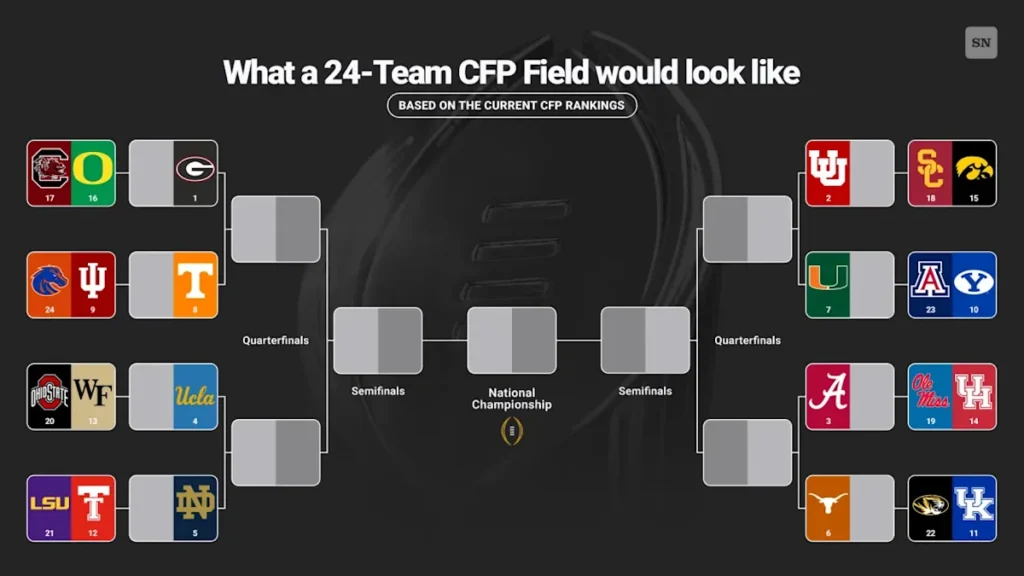

The College Football Playoff officially confirmed Monday that it will double its postseason field to 24 teams starting next season, a structural shift that fundamentally alters the competitive landscape for every program in the country. This expansion follows the conclusion of the 12-team format’s third and final iteration this year, signaling an immediate end to the current playoff structure. Under the new rules, the top eight seeds will earn automatic byes to the second round, while teams ranked 9 through 24 will compete in first-round games hosted at campus sites.
Current rankings reveal how the expanded field reshapes seeding and byes.
Applying the committee’s current CFP rankings to this hypothetical 24-team bracket reveals a dramatic change in postseason viability for several high-profile programs. Teams currently fighting for survival in the 12-team model, such as LSU, Iowa, and Texas Tech, would be comfortably inside the cut line next November, with their primary concern shifting from qualification to seeding. Furthermore, programs that have suffered significant losses this season, including Ohio State, Oregon, and Ole Miss, would still secure spots within the expanded field, highlighting how the new format dilutes the impact of individual defeats.
This expansion effectively guarantees that a much broader range of teams will participate in the postseason, reducing the volatility of the final weeks of the regular season. While the move has faced widespread opposition from college football fans who argue it devalues the championship, the administrative decision is now final. As the current 12-team bracket plays out, analysts and fans alike are already mapping out how the 24-team structure will reshape conference dynamics and recruiting strategies for the upcoming cycle.
Source: Yahoo Sports